Brick Breaker
ArcadeHow to play
Launch the ball, then slide the paddle to bounce it into the bricks and clear every breakable block to advance. Where the ball hits the paddle sets its angle — edges steer it sharply, the centre sends it straight up. Do not let the ball fall past the paddle or you lose a life. Marked bricks drop wider-paddle, multi-ball and slow-motion power-ups.
Controls
Keyboard: Left/Right arrows or A/D to move the paddle; Space or Up to launch the ball.
Touch & mouse: drag left/right to move the paddle; tap or click to launch.
What is Brick Breaker?
Brick Breaker is a fast, skill-based arcade game built around one simple loop: a ball ricochets around the play field, and you slide a paddle along the bottom to keep it alive and steer it into a wall of bricks. Every brick you touch adds to your score, and the goal on each board is to clear away every breakable block. It is pure paddle-and-ball action — free to play, score-based, and with nothing to sign up for. Your best result is saved right on your own device, so there is always a personal target to chase without any account or login.
This build ships twelve hand-designed brick layouts. Each one is its own small puzzle of angles, gaps, tougher multi-hit bricks and immovable walls, and they get denser and trickier as you progress. Because the layouts are fixed rather than generated, you can genuinely learn them: a board that felt impossible on your first attempt becomes a familiar rhythm once you know where the awkward bricks sit and how the ball tends to travel through them.
The heart of the game is angle control. Where the ball meets your paddle decides where it goes next, and mastering that single relationship is what separates a frantic scramble from a calm, deliberate clear. Everything else — the power-ups, the difficulty modes, the multi-hit bricks — sits on top of that one core skill.
The core rules in plain language
The rules are easy to state and take a while to master:
- A single ball bounces around a rectangular field. It reflects off the left, right and top walls automatically.
- You control a paddle near the bottom. If the ball drops below the paddle and off the bottom edge, you lose a life.
- Steer the ball into bricks to break them. Clear every breakable brick on a board to advance to the next of the twelve layouts.
- Bricks come in strengths. A one-hit brick breaks immediately; sturdier bricks need two or three clean hits before they go.
- Some bricks are solid, hatched blocks that never break. They are obstacles to play around, not targets.
- Certain marked bricks always release a helpful power-up when destroyed — more on those below.
- Run out of lives and the game ends. Clear all twelve layouts and you have finished the game.
That is the whole game. There is no chance-based reward, no money, and nothing random deciding your fate — only how well you read the ball and place your paddle.
How to play, step by step
Starting a run takes seconds. Here is the full sequence, with both keyboard and touch controls, since the game supports both fully.
- Pick a difficulty — Easy, Medium or Hard. This sets your paddle width, ball speed and starting lives (details in the difficulty section below).
- Launch the ball. At the start of each life the ball sits ready on your paddle. On a keyboard, press Space, the Up arrow or W to send it off. On a touchscreen or with a mouse, simply tap or click the play field. The ball launches upward with only a tiny spread, so its opening direction is predictable.
- Move the paddle. On a keyboard, hold the Left/Right arrows or A/D to glide the paddle. With touch or mouse, drag left and right — the paddle follows your finger or pointer directly, so you can position it exactly.
- Return the ball by catching it on the paddle. The spot where it lands sets the rebound angle, which is the skill you will spend most of your time refining.
- Break the bricks. One-hit bricks vanish on contact; two- and three-hit bricks show small pips marking how many hits remain, and change appearance as they weaken.
- Grab power-ups. When a marked brick breaks, a labelled capsule falls. Move your paddle under it to catch it and trigger its effect.
- Clear the board to move on. Between levels a short message appears; tap the button, press Enter, or click to start the next layout.
- Game over or victory. Lose your last life and you see a Game over prompt; clear all twelve layouts and you get the win screen. Press Enter or tap the button to play again from the first board.
You can mix input methods freely. Reaching for the arrow keys instantly hands control back to the keyboard; touching or moving the pointer hands it back to direct positioning. Use whichever feels natural in the moment.
The full control list
- Left arrow / A — move paddle left (keyboard).
- Right arrow / D — move paddle right (keyboard).
- Space / Up arrow / W — launch the ball when it is resting on the paddle.
- Enter — confirm the next-level prompt, or start a fresh game after a win or game over.
- Drag (touch or mouse) — slide the paddle directly to that position.
- Tap / click — launch the waiting ball.
How the paddle steers the ball
This is the concept worth learning first, because it drives everything else. The paddle is not a flat mirror that simply reverses the ball. Instead, the ball’s rebound depends on where along the paddle it lands:
- Catch the ball on the dead centre of the paddle and it rebounds nearly straight up.
- Catch it toward the left edge and it kicks off to the upper left.
- Catch it toward the right edge and it kicks off to the upper right.
The further from centre the contact point, the sharper the sideways angle — but the steer is capped, so even an extreme edge hit will not send the ball flatter than a fixed limit. That cap exists for a good reason: it stops the ball ever settling into a dull, near-horizontal loop that bounces sideways forever. The game also enforces a minimum vertical speed after every bounce, so the ball always keeps making meaningful upward or downward progress rather than skimming along.
The practical takeaway: your paddle is a steering wheel, not just a wall. By choosing where the ball meets it — and even nudging the paddle at the instant of contact — you decide where it heads next. We have a dedicated walkthrough on this in the blog guide Brick Breaker: controlling the ball angle, which is well worth a read once you have the basics down.
The three difficulty modes
Before each game you choose one of three modes. They do not change the twelve layouts — those stay identical — but they change how much room for error you have.
Easy
Easy gives you the widest paddle, the slowest ball, and an extra life to work with. It is the mode for learning the layouts, practising angle control, and getting comfortable with the power-ups. The gentler pace lets you watch the ball’s line well in advance and glide calmly into position.
Medium
Medium is the standard challenge: a normal-width paddle, a noticeably quicker ball, and the standard life count. This is the mode most players settle into once they know how the game feels. The ball moves fast enough to demand real attention but slow enough to reward good reads.
Hard
Hard narrows the paddle and speeds the ball up considerably, with no spare life to fall back on. Small mistakes are punished, and clearing the denser late layouts becomes a genuine test of nerve and precision. Come here once you can comfortably clear several boards on Medium.
Each difficulty keeps its own saved best score on your device, so improving on Easy and chasing a Hard record are separate, parallel goals.
Bricks: reading what you are hitting
Not every block behaves the same, and telling them apart quickly is a real skill.
- One-hit bricks break the moment the ball touches them. Most of a board is made of these.
- Two-hit and three-hit bricks need repeated hits. They carry small pip marks showing how many hits are left, and their look shifts as they weaken, so you always know how close they are to breaking without relying on colour alone.
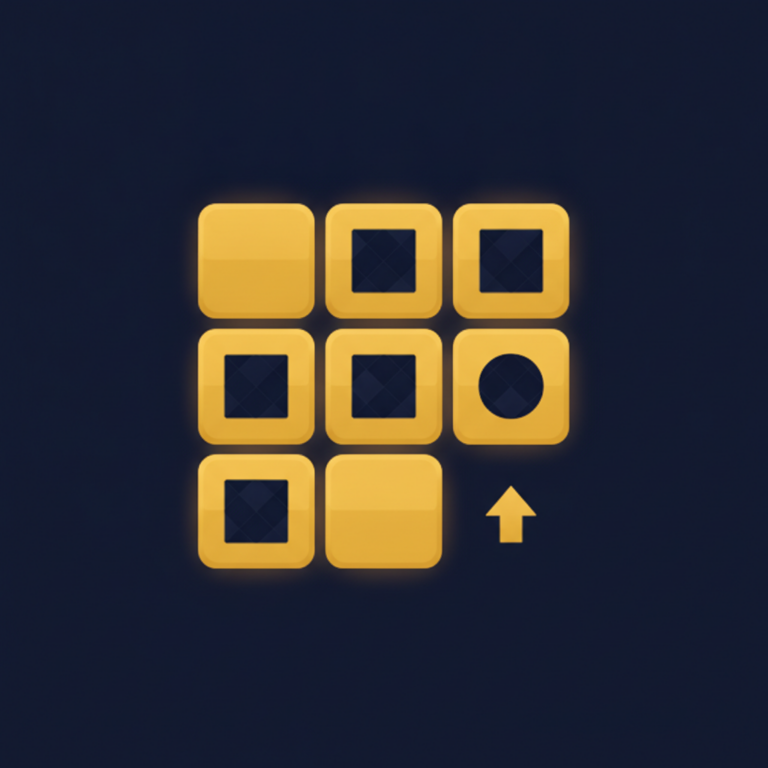
- Solid, hatched blocks are indestructible. A diagonal hatch line marks them so they are unmistakable even if you cannot rely on colour. The ball bounces off them like a wall — use them as ricochet surfaces rather than fighting them.
- Marked power-up bricks (W, M, S) are one-hit bricks that always drop a capsule when destroyed.
Because multi-hit bricks show their remaining strength as pips, you can prioritise. On a crowded board it often pays to soften up the toughest bricks early while you have lanes open, rather than leaving a cluster of three-hit blocks for the anxious final moments.
Power-ups on a fixed schedule
This is where Brick Breaker deliberately parts ways with chance. The power-up bricks are baked into each layout at fixed positions — there is no random roll, no lucky drop. If a board contains a W, an M and an S brick, those exact three capsules are available every single time you play it, in the same spots. That means you can plan your route to collect them, which is a skill, not luck.
When you destroy a marked brick, its capsule falls slowly toward the bottom. Catch it on your paddle to activate it:
- W — Wider paddle. Your paddle grows substantially for a limited time, giving you more margin to return the ball. When the effect ends it shrinks back to its normal width.
- M — Multi-ball. Two extra balls spring from your current ball, so you suddenly have several in play at once. More balls mean faster clearing, but also more to track — keep as many alive as you can.
- S — Slow motion. The action slows for a while, giving you time to line up a difficult return or thread the ball into an awkward gap. The paddle changes colour while slow motion is active so you always know it is on.
Note that all timed effects reset when you lose a life — a fresh ball starts clean — so treat a power-up as a window of opportunity, not a permanent upgrade. Also, catching capsules is optional: if a falling capsule is on the far side of the board and chasing it would risk the ball, let it go. A dropped power-up costs you nothing.
Strategy: from beginner to advanced
The bulk of getting good at Brick Breaker is habit and planning. Here is a progression you can actually work through.
Beginner habits
- Watch the ball, not the bricks. Beginners stare at the wall they want to hit; better players watch the ball’s line and get the paddle there early. Position first, aim second.
- Glide, do not lunge. Start moving as soon as you can read where the ball is going. Late, panicky dashes are how the ball slips past the edge of the paddle.
- Return to the middle. When you are not aiming for anything specific, drift the paddle back toward centre between returns. From the middle you can reach a ball heading to either side.
- Use centre hits to stay safe. Catching the ball near the paddle’s centre sends it up steeply and predictably, which keeps rallies calm while you plan.
Intermediate play
- Aim with the edges on purpose. Once you trust your paddle control, use edge hits to steer the ball toward specific bricks you still need, or into a gap so it can attack a cluster from a better angle.
- Open a channel to the top. A classic tactic: carve a vertical gap through the wall so the ball can slip above the bricks and rattle around up there, clearing many blocks while you barely touch it. Fixed layouts make this plannable.
- Bounce off the solid blocks. Treat indestructible bricks and the side walls as ricochet surfaces. A shot that banks off a wall can reach a corner brick you could never hit directly.
- Clear the exits first. On dense boards, breaking the bricks nearest the open lanes early keeps future paths open and stops the ball getting stuck pinballing in a shrinking pocket.
Advanced tactics
- Route-plan your power-ups. Because the W, M and S bricks never move, decide in advance which order to trigger them. Slow motion right before a tricky multi-ball catch, or a wider paddle before you commit to a fast clear, can make a hard board feel manageable.
- Manage multi-ball deliberately. Multi-ball clears bricks quickly but scatters your attention. Try to keep the balls loosely together so one paddle position covers several, and accept that losing one of several balls is fine — you only lose a life when the last one drops.
- Respect the speed on Hard. The faster the ball, the earlier you must read it. On Hard, commit to a paddle position the instant you know the ball’s line rather than tracking it all the way down.
- Set up the last bricks. Late in a board, think one bounce ahead so your final returns feed the ball toward the last stubborn blocks instead of into empty space.
Common mistakes and how to fix them
- Chasing the ball with tiny corrections. Fix: decide on a target position and move there in one smooth motion, then wait.
- Always hitting from the centre. Safe, but you never steer. Fix: once comfortable, practise deliberate edge hits to aim.
- Letting the paddle drift to a corner. Fix: default back to the middle so you can cover both sides.
- Ignoring multi-hit bricks until the end. Fix: soften up two- and three-hit bricks while lanes are open, using the pip counts to prioritise.
- Diving after every power-up. Fix: only chase a capsule when you can catch it without endangering the ball. A missed power-up is free.
- Fighting the solid blocks. Fix: accept they will never break and use them as bounce surfaces instead.
- Playing Hard too early. Fix: build angle control on Easy and Medium first; the fast ball on Hard only rewards reads you already have.
Scoring and beating your best
Scoring is straightforward: every time the ball strikes a brick, your score climbs. That means multi-hit bricks reward you for each hit on the way to breaking them, and clearing more of the board naturally lifts your total. Your highest score is stored locally on your device, per difficulty, so it is there next time you return — no account, no sign-in, nothing sent anywhere.
To push your best higher:
- Survive longer. More lives spent in play means more bricks touched. Clean returns are the foundation of a high score.
- Progress through the layouts. Reaching the denser late boards puts far more bricks within reach.
- Use multi-ball wisely. Several balls at once rack up brick contacts fast — keep them alive.
- Learn the fixed layouts. Since boards repeat, each attempt is a chance to route more efficiently through the parts that cost you last time.
Is this gambling? No.
Brick Breaker is a free skill game and nothing more. There is no money involved, no purchase of any kind, and no chance-based reward system. No outcome is decided by luck, and no reward is handed out by chance. The power-ups appear on a fixed schedule from fixed bricks, the layouts are the same every time, and your score is determined entirely by how well you read and return the ball. What looks like “luck” — the ball finding a good angle — is really the result of where you placed the paddle. It is a test of reflexes and planning, in the same family as any classic arcade challenge.
Accessibility
The game is built to be playable and readable in more than one way:
- Full keyboard play. The paddle and launch are entirely keyboard-driven, so no pointing device is required.
- Colour is never the only signal. Solid indestructible blocks carry a diagonal hatch mark, and multi-hit bricks show pip counts, so you can tell block types apart without relying on colour perception.
- Spoken status updates. Level, lives and key events are announced for screen-reader users, and the play field carries a descriptive label.
- A clear focus outline shows when the game has keyboard focus.
- Reduced-motion support. If your device requests reduced motion, the game skips the small particle effects, keeping the essential action clear and calm.
- A text HUD shows your level and remaining lives in plain characters, not just icons.
Playing on mobile and older phones
Brick Breaker is comfortable on a touchscreen. Drag your thumb left and right to slide the paddle exactly where you want it, and tap to launch. Because the paddle follows your finger directly, touch control is precise — often more so than keyboard for fine positioning.
- Rest your thumb below the play field so your hand never covers the ball or the bricks.
- Play in the orientation that gives the paddle the most travel for your device — a little more width makes edge aiming easier.
- Older phones are fine. The play field scales to your screen and the game is drawn efficiently, so it stays smooth on modest hardware. If you want the calmest experience, enable your device’s reduced-motion setting to switch off the extra particles.
- The field blocks page scrolling while you play, so dragging the paddle will not accidentally scroll the page.
Related games and guides
If you enjoy Brick Breaker’s mix of quick reflexes and route planning, try these other free skill games on the site:
- Snake — another reflex-and-planning classic where you plot a safe path through your own growing trail.
- Block Drop — fit falling shapes into clean rows under gentle time pressure.
- 2048 — a calmer, turn-based puzzle for when you want to think rather than react.
For a deeper dive into the one skill that matters most here, read our guide Brick Breaker: controlling the ball angle.
A friendly send-off
Brick Breaker rewards patience as much as reflexes. The first few boards teach you to read the ball; the later ones ask you to plan a route through it. Take the difficulties in order, learn the fixed layouts, treat the paddle as a steering wheel rather than a wall, and use the fixed-schedule power-ups on purpose. Do that and the frantic scramble turns into something that feels almost like a rally — calm, deliberate, and quietly satisfying. There is no money, no chance and nothing to lose but a little time. Load a board, launch the ball, and see how far into the twelve layouts you can go.